
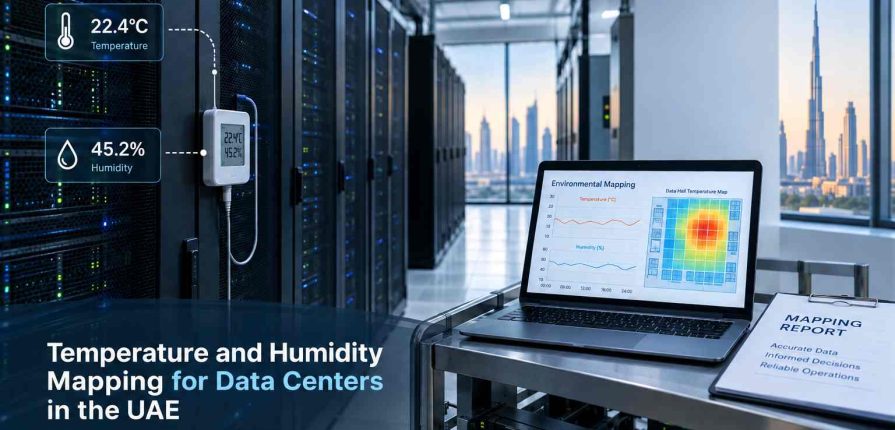
Temperature mapping in the UAE is often associated with pharmaceuticals and cold chain logistics, but temperature and humidity mapping for data centers is equally important for protecting critical IT infrastructure.
With Dubai and Abu Dhabi emerging as major hubs for hyperscale and colocation facilities, edge data centers, and enterprise server rooms, maintaining stable environmental conditions is essential. Unlike a pharmaceutical refrigerator, where temperature excursions can affect stored products, a data center can face equipment stress, hardware failure, downtime, and SLA-related risks when temperature, humidity, or airflow conditions move outside the required range.
Why Data Centers Need Environmental Mapping, Not Just Monitoring
Most data centers already use a Building Management System (BMS) with fixed sensors to monitor environmental conditions at selected points. However, temperature and humidity mapping for data centers provides a much broader view of how conditions vary throughout the facility. Unlike routine monitoring, mapping is a structured study that uses multiple calibrated data loggers to identify temperature variations, hot spots, humidity differences, and potential airflow issues across the data hall under representative operating conditions.
A BMS sensor may show that conditions are within the required range at one location, while another area of the data hall experiences different conditions due to rack density, cooling distribution, aisle containment, or airflow patterns. Temperature and humidity mapping helps identify these variations, allowing facility teams to evaluate cooling performance, address environmental problem areas, and determine whether existing sensor locations provide adequate coverage.
What UAE Data Centers Are Measured Against
Server room conditions in the UAE are generally benchmarked against:
- ASHRAE TC9.9 thermal guidelines — recommended and allowable temperature/humidity envelopes for IT equipment classes (A1–A4)
- TIA-942 — data center infrastructure standards, including environmental control expectations
- Uptime Institute Tier standards, where applicable, for redundancy and resilience of cooling systems
- Manufacturer warranty conditions for servers, storage, and networking hardware, which can be voided by sustained excursions outside rated ranges
None of these are UAE-specific regulations in the way SFDA or MOH rules apply to pharma — they’re international benchmarks operators choose to comply with for insurance, warranty, and operational risk reasons.
The Mapping Process for a Server Room or Data Hall
A structured temperature and humidity mapping for data centers study helps identify environmental variations throughout the data hall and provides reliable data for evaluating cooling and monitoring strategies.
- Study design — Identify rack rows, cold/hot aisle configuration, CRAC/CRAH unit placement, and any known problem zones flagged by facilities staff.
- Sensor placement — Calibrated data loggers positioned at multiple heights (typically top, middle, bottom of rack) across the room, plus supply and return air points.
- Worst-case load testing — Mapping is run during peak load and, ideally, during a simulated or planned cooling-failure scenario, not just at idle.
- Data collection period — Continuous logging over a defined study window to capture daily load cycles and any transient events.
- Analysis and reporting — Traceable, ISO 17025-aligned reporting showing excursions, hot spot locations, and recommendations for sensor relocation or containment fixes.
- Requalification schedule — Data halls change constantly as racks are added or reconfigured, so mapping is typically repeated after significant layout changes or on a periodic cycle.
What Goes Wrong Without It
- Undetected hot aisles that shorten hardware lifespan long before failure is obvious
- Humidity extremes — too low, and static discharge risk rises; too high, and condensation and corrosion risk rises, both common concerns given Dubai’s ambient humidity swings
- BMS blind spots where the fixed sensor reads fine but the actual equipment doesn’t
- Warranty and insurance disputes after a failure, with no traceable evidence of the environmental conditions the hardware actually experienced
How Westcal Approaches Data Center Mapping
Westcal provides temperature and humidity mapping for data centers using calibrated, traceable data loggers and a structured approach designed for critical infrastructure environments. Building on our experience in pharmaceutical warehouses and cold chain environments, we apply the same focus on measurement accuracy, data integrity, and documented results to data center applications.
For data centers, our mapping studies can include:
- Full-room temperature and humidity mapping under representative operating conditions
- Assessment of temperature variations, hot spots, and humidity differences across the data hall
- Traceable calibration certificates for all measurement equipment used
- Clear, audit-ready reports for facilities, IT, engineering, and compliance teams
- Identification of potential BMS sensor blind spots and recommendations for improved sensor placement
- Practical observations to support cooling and airflow management decisions
If your facility is located in Dubai, Abu Dhabi, Sharjah, or elsewhere in the UAE, an independent environmental mapping study can help identify potential temperature, humidity, and monitoring gaps before a major hardware refresh, expansion, or infrastructure change.

Affan Mohammed is the Technical Manager at Westcal Instrumentation & Calibration Services LLC with over 11 years of experience in electronics and instrumentation. He specializes in calibration services, temperature mapping, and precision measurement systems, ensuring accurate and compliant calibration solutions for industrial applications across the UAE.
Recent Comments